Key Takeaways:
- Strong medical evidence often determines the outcome of an Ohio workers’ compensation claim, especially when disputes arise over causation, treatment, prior injuries, or work restrictions.
- Successful claims usually rely on three categories of evidence: factual evidence showing how the injury occurred, legal evidence documenting employment and compensation issues, and medical evidence connecting the condition to the workplace incident.
- Medical records, physician opinions, diagnostic imaging, disability certifications, and narrative reports help establish diagnosis, causation, treatment necessity, impairment, and return-to-work limitations.
- Inconsistent injury descriptions, missing records, inaccurate medical histories, and contradictory testimony can weaken a claim and create long-term disputes during the workers’ compensation process.
- Narrative medical reports and targeted physician questionnaires may become especially important in occupational disease claims, repetitive trauma injuries, treatment disputes, and cases involving pre-existing conditions.
- Employers, insurers, and the Bureau of Workers’ Compensation may review incident reports, wage records, OSHA materials, witness statements, social media activity, and prior claim history when evaluating a workers’ compensation claim.
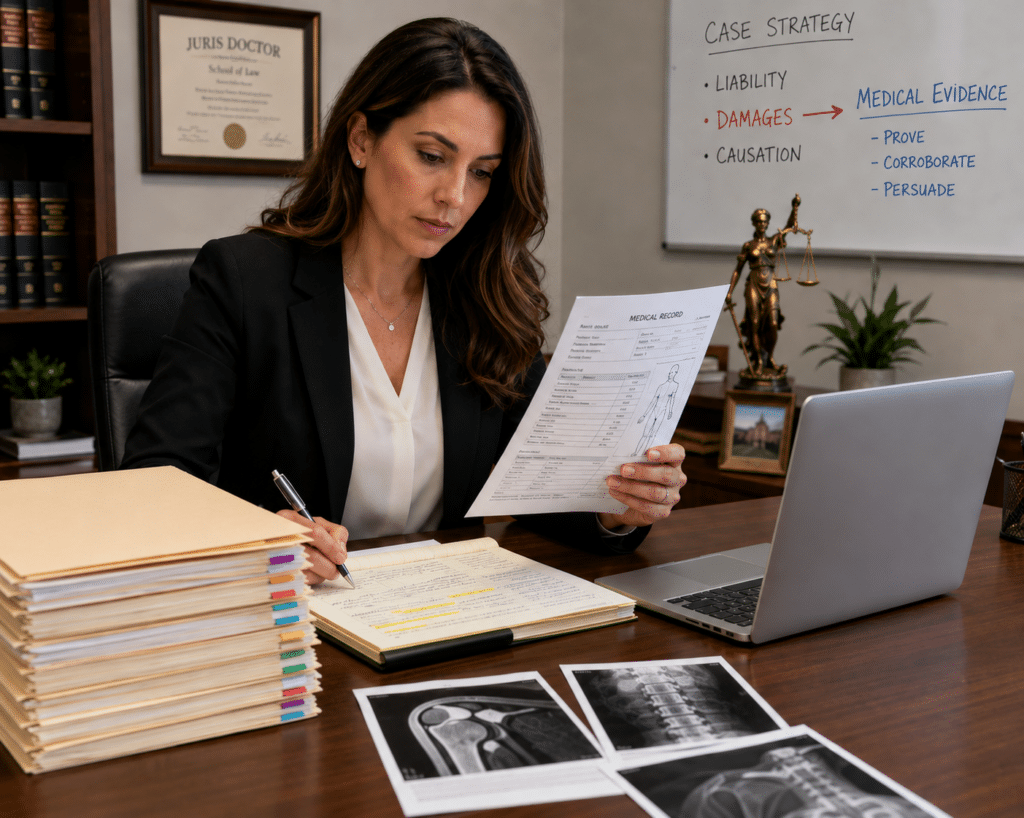
When you file a workers’ compensation claim in Ohio, you’ll need to provide evidence of your job-related injury and its impact on your ability to do your job. Specifically, you want to assemble the following:
- Factual evidence that establishes what happened and how;
- Legal evidence that documents your employment relationship, your wages, and the rules that governed your workplace;
- Medical evidence that connects your injury to that workplace event and defines the impact on your ability to work.
Medical documentation is especially important when disputes arise regarding causation, prior injuries, treatment necessity, or return-to-work capacity. In many claims, the outcome depends on the quality, consistency, and credibility of the medical evidence submitted in support of the claim. In this article, we’ll outline what you need to know and how an Ohio workers’ compensation lawyer can make a difference.
Factual Evidence in Ohio Workers’ Compensation Claims
Factual evidence documents the workplace event that led to the injury claim. It shows where the incident occurred, what job activity you performed, who observed the event, and how symptoms developed afterward. Medical records identify the diagnosis, but factual evidence explains how the workplace injury happened.
- Injured Worker Testimony: You should review prior reports, medical histories, and claim documents before answering questions under oath. If you report lifting a heavy pallet in the emergency room record but later testify that the injury occurred while pushing equipment, the employer may push back.
- Photos and Video Evidence: Many employers maintain surveillance systems inside warehouses, factories, retail stores, and distribution facilities. If footage captured the incident, you or your workers’ compensation lawyer should request preservation immediately. Photos taken shortly after the incident may also document your injuries or hazardous work conditions.
- Witnesses and Witness Statements: Coworkers, supervisors, customers, and bystanders may provide testimony regarding the workplace incident or your condition immediately afterward. Make sure that your legal representative knows what information a witness is expected to provide before requesting testimony or written statements.
- Social Media Evidence: Employers and insurers review Facebook, Instagram, TikTok, YouTube, and other platforms for photographs, videos, comments, check-ins, and posts that may contradict your claim. If you’re seen lifting heavy items when your claim involves work restrictions or temporary total disability compensation, you risk fraud allegations.
- Bureau of Workers’ Compensation (BWC) Notes: BWC notes may contain conversations with both the employer and the injured worker. These notes can include reporting timelines, injury descriptions, claim decisions, employer objections, treatment discussions, and statements made during claim administration.
- Settlement Research and Claim History: Settlement records, prior treatment notes, C-92 examination reports, and the last treatment note from an older injury claim may help identify what symptoms resolved before your new injury.
Legal Evidence in Ohio Workers’ Compensation Claims
Medical records may establish the diagnosis, but legal evidence connects the physical injury to your employment status, work duties, reporting history, and compensation eligibility. Missing records, inconsistent reporting, or incomplete documentation may create disputes that continue throughout the claim.
- Employment Contracts and Collective Bargaining Agreements: Employment contracts and collective bargaining agreements (CBAs) may contain language affecting job duties. For example, a CBA may require drivers to maintain communication equipment inside company vehicles during work shifts. If an injury occurs while using this equipment, the agreement may support your position, but please note that a CBA can be contrary to law.
- Benefit Documentation: Short-term disability records, long-term disability files, health insurance documentation, and leave records may contain information affecting your workers’ compensation claim.
- Incident Reports: Hearing officers will ask about these reports, so make sure you have a copy of yours. You should also request any investigation materials created after the incident report: Employers may conduct internal interviews, safety reviews, equipment inspections, or supervisor investigations that turn up evidence related to the claim.
- OSHA Investigations: OSHA inspection reports may support your position regarding unsafe work conditions or employer knowledge of workplace hazards. Please note that these investigations may take several months to complete. In some claims, the OSHA file may not become available until after treatment disputes or compensability hearings already begin.
- Witness Statements: Written witness statements may confirm reporting timelines, job duties, safety concerns, work restrictions, or your physical condition immediately after the incident. These statements don’t need to be notarized to become useful evidence, although it can be helpful.
- Wage Records: You should review your wage records carefully for missing overtime, bonuses, shift differentials, or payroll errors. Incorrect wage calculations may reduce compensation payments throughout the life of the claim.
- Case Law: Questions involving voluntary abandonment, jurisdiction, occupational illness standards, employment status, or disability eligibility may call for legal research and case law analysis. Please note that under Ohio Revised Code section 4123.56(F), some proceedings limit what non-attorney representatives may argue during litigation.
- BWC Forms: Ohio Bureau of Workers’ Compensation forms contribute to the administrative record reviewed during hearings. You should review every form carefully before submission: Incorrect dates, incomplete work injury descriptions, or inaccurate work restrictions may create disputes later in the claim.
Medical Evidence in Ohio Workers’ Compensation Claims
Treatment records, physician opinions, diagnostic imaging like CT scans, disability certifications, and narrative reports document your diagnosis, explain the mechanism of injury, and support compensation or treatment requests.
- Medical Records: The first treatment note usually receives the closest scrutiny because it documents the earliest injury history, symptom complaints, body parts involved, and causation.
- Opinion Evidence: Medical opinion evidence addresses causation, disability status, impairment, treatment necessity, and future medical care. Physician opinions become especially important when the employer disputes whether the workplace incident caused the diagnosed condition.
- FROI Forms: The First Report of Injury, Occupational Disease, or Death form, commonly called the FROI, identifies the work injury date, body parts involved, employer information, and reported workplace incident. However, the form usually contains limited detail, so you’ll also want the C-30 forms too.
- C-30 Forms:The C-30 form allows the treating provider to supply additional medical detail regarding diagnosis, causation, disability status, and treatment recommendations. Ohio Administrative Code rules prohibit providers from charging injured workers for completing certain BWC forms.
- Narrative Reports: Narrative medical reports provide a detailed medical analysis. But it’s important to note that these reports can cost $300.00 – $750.00 or more, which can amount to a week or two of disability pay. If you do request it, review the report carefully before submission because any inaccuracies may damage the claim instead of supporting it.
Obtaining Medical Evidence
Medical documentation may come from hospitals, urgent care facilities, physical therapy providers, specialists, imaging centers, employers, managed care organizations, and the Bureau of Workers’ Compensation itself.
- Requesting Records From Medical Providers: Most medical records require a signed HIPAA authorization before release. Many providers also have office-specific authorization forms in addition to standard medical release documents. You should also request a copy of your patient history sheet along with these records.
- Requesting Records From Employers: Self-insured employers must also provide medical and indemnity printouts related to the claim: These printouts may help identify whether any key records are missing.
How Can You Reduce Medical Record Costs
Medical record expenses can increase quickly. If your employer is self-insured, ask for their file first, as they may already have many of the records needed for the claim. You may also ask providers to send records directly to the Bureau of Workers’ Compensation instead of requesting duplicate copies. That approach may reduce copying charges, but it can also create risk because irrelevant or harmful records may enter the claim file without prior review.
Other ways to reduce costs include:
- Limit record requests by treatment date, body part, or provider. Broad requests may produce hundreds of pages unrelated to the workplace injury.
- Give your workers’ compensation attorney permission to log into your medical records portal, such as MyChart. These systems may allow you to obtain records within minutes instead of waiting weeks for mailed responses from medical records departments.
Providing Medical Releases to Employer Representatives
Ohio Administrative Code provisions require injured workers to cooperate with reasonable medical record requests connected to the claim. Employers and managed care organizations may request records related to the body parts, diagnoses, treatment history, or disability periods at issue in the claim. This authorization is usually valid for 60 days. You’ll also want to limit the scope of the release to avoid disclosure of irrelevant and potentially embarrassing medical information.
Narrative Medical Reports and Medical Questionnaires
When to Request a Narrative Report
- You Suffered an Occupational Disease: Occupational disease claims can benefit from detailed physician analysis because the provider must explain how workplace exposure caused the diagnosed condition over time.
- You Have a Repetitive Trauma Injury: A physician may need to explain how repeated work activities produced the condition instead of a single traumatic incident.
Narrative reports also become important when an employer argues that a non-work incident caused the condition. If you experienced a weekend injury, prior surgery, pre-existing arthritis, or earlier treatment involving the same body part, the physician may need to explain why the workplace incident still caused the current disability or aggravated the prior condition.
Here are some tips for requesting narrative reports:
- Provide the physician with an accurate and detailed history.
- Include direct questions requiring clear answers.
- Ask for a response to an employer medical exam.
- Provide other records for review, such as diagnostic reports and pre-injury records.
When a Questionnaire May Work Better
Medical questionnaires can obtain physician opinions without requesting a full narrative report. Not only are they less expensive, but office notes can fail to address causation directly. A questionnaire allows the provider to answer targeted medical questions tied to the disputed issue in the claim.
What to Watch for in Narrative Reports
- Accurate Description of the Injury: The narrative report should be consistent with the incident report, FROI, treatment records, and testimony already contained in the claim file. Employers regularly compare each version of the injury description when disputing causation or credibility.
- Acceptance of Allowed Conditions: Employer medical examiners must accept the allowed conditions directly when preparing causation opinions, disability evaluations, or treatment reviews.
- Discrepancies, Contradictions, and Omissions: Inconsistent timelines, omitted treatment history, inaccurate symptom progression, or conflicting diagnostic interpretations may weaken the physician’s opinion.
Six Major Points in Narrative Reports
Narrative reports should address six primary medical issues connected to the claim.
- Diagnosis: The report should identify the diagnosis involved in the dispute, including original allowances or requested additional conditions.
- Supporting Documentation: It should also include the medical history and mechanism of injury supporting the physician’s conclusions. Consistency with the injured worker prior statement/ FROI will strengthen the report.
- Statement of Cause: The physician should state whether the condition resulted from direct injury, flow-through injury, or substantial aggravation of a pre-existing condition. Make sure your doctor is consistent throughout the report
- Evidence Supporting Cause: All information in the statement of cause should be backed up by solid medical evidence.
- Impairment: The narrative report must clearly explain the nature and extent of your injury-related impairment.
- Prognosis: A prognosis is a medically informed prediction about how a disease or injury will develop over time. It estimates your chances of recovery, potential complications, and other relevant criteria.
AI and Evidence: Use Caution With Confidential Information
You should never enter confidential injured worker information into public AI platforms. Public systems such as ChatGPT, Gemini, Claude, or Copilot may retain submitted information through external servers or internal data handling systems outside the workers’ compensation claim itself. Once confidential information enters a public AI system, retrieval and deletion may become impossible.
AI systems may still assist with general medical research when confidential information is removed completely. For example, someone may research whether adhesive capsulitis surgery may later contribute to glenohumeral osteoarthritis without identifying the injured worker involved in the claim. Private AI systems also exist for law firms and medical organizations handling confidential information internally, but these systems can be very expensive.
Medical Evidence in Treatment Disputes
- ODG and Treatment Guidelines: Official Disability Guidelines, commonly called ODG, are routinely used by managed care organizations and utilization review physicians when approving or denying treatment requests. While they can be used to benefit injured workers, doctors sometimes misunderstand, exaggerate, or miss the underlying medical condition.
- Questionnaires: If office notes fail to explain why injections, therapy, supportive care, or medication management remain necessary, a physician questionnaire may address the issue directly.
- Supportive Care: Ohio Administrative Code Rule 4123-6-31.1 addresses supportive care treatment for injured workers. Chiropractic treatment, injections, pain management care, and maintenance treatment may remain medically necessary even after the worker reaches maximum medical improvement in some claims.
Conditions Versus Billing Codes
The Industrial Commission usually evaluates the diagnosed condition itself instead of the ICD billing code attached to the treatment request. Only in rare situations will an Industrial Commission order identify an ICD code instead of the condition itself. On the other hand, the BWC is more concerned with codes because codes drive billing, authorization, and claim administration.
Psychological Evidence in Workers’ Compensation Claims
Psychological conditions generally must arise from the physical workplace injury and resulting impairment. Frustration with the workers’ compensation system, disputes with the employer, financial concerns, or changes in personal relationships usually don’t satisfy the legal standard for compensable psychological conditions.
Note: Armstrong v. John R. Jurgensen Co addressed PTSD claims in Ohio workers’ compensation law. The Ohio Supreme Court ruled that a psychological condition such as PTSD was compensable only if it arose from the worker’s physical injury or occupational disease.
Treating psychologists, psychiatrists, counselors, and physicians may provide records supporting the psychological condition. Psychological diagnoses generally rely on the Diagnostic and Statistical Manual of Mental Disorders, Fifth Edition, commonly called the DSM-5. This publication identifies diagnostic criteria used by psychologists and psychiatrists when evaluating mental health conditions.
Occupational Disease Evidence
Occupational disease claims require medical evidence connecting the diagnosed condition to workplace exposure.
- MSDS Sheets and Chemical Records: Material Safety Data Sheets, commonly called MSDS sheets, identify chemical contents, known health risks, required safety equipment, ventilation standards, and handling procedures connected to workplace substances.
- OSHA Investigation Reports: OSHA Establishment Search records can identify prior safety violations or inspection history connected to the employer. These records may support allegations involving repeated exposure to hazardous substances or unsafe industrial conditions.
- BWC VSSR (Violation of Specific Safety Requirement) and Safety Investigation Materials: VSSR claims involve allegations that the employer violated specific safety requirements connected to the workplace injury or disease.
- Division of Safety and Hygiene: Division of Safety and Hygiene records may also contain safety manuals, industry publications, training materials, workplace standards, or inspection information related to the occupational disease allegations.
Occupational disease claims frequently require detailed narrative medical reports. Standard treatment notes rarely provide enough analysis to address workplace exposure history, latency periods, causation standards, competing medical explanations, and diagnostic support.
Get a Free Consultation From an Ohio Workers’ Compensation Attorney
You should know what evidence exists before the claim reaches hearing. You should also know what evidence is missing. Missing treatment records, inconsistent injury descriptions, incomplete diagnostic testing, inaccurate physician histories, or vague disability opinions may create disputes that continue throughout the claim. This is why it’s important to develop relationships with doctors’ offices and their staff: Their knowledge and access to what you need is invaluable.
At Plevin & Gallucci Company, L.P.A., we represent injured workers in Ohio workers’ compensation claims involving workplace injuries, occupational diseases, and more. We work with medical providers, review claim documentation, prepare evidence for hearings, and address disputes involving employer medical examinations and causation challenges. For more information or to schedule a free initial consultation, call our law firm at 1-855-4-PLEVIN or use our contact form.
Helpful Medical Sites
Finding Information
- Federal Department of HHS
- National Library of Medicine
- American Medical Association
- American Academy of Family Physicians
- Cleveland Clinic