BOTTOM LINE UP FRONT: Cleveland’s 2024 crash data shows that wet pavement contributed to 1,431 reported crashes and snow-covered or icy roads contributed to another 516, even though most crashes still happened in clear weather. Plevin & Gallucci, representing injured Ohioans since 1971 from its Cleveland office at 55 Public Square, explains what Ohio law says about liability when weather or road conditions play a role in a crash. Weather does not excuse a driver from adjusting their speed and following distance to match the conditions.
Key Takeaways
- Most crashes still happen in clear weather. Of 7,636 crashes reported in the city of Cleveland in 2024, 4,840 occurred in clear conditions, largely because clear days carry the most overall traffic.
- Wet roads are a real factor. 1,431 crashes, about 18.7% of the total, happened on wet pavement.
- Snow and ice add up over a Cleveland winter. Snow-covered roads contributed to 356 crashes and icy roads to another 160.
- Dusk crashes cluster with rush hour. Dusk conditions were present in 2,460 crashes, nearly a third of the citywide total, overlapping heavily with Cleveland’s evening commute during shorter-daylight months.
- Ohio law does not treat weather as a defense on its own. A driver is still expected to adjust speed and following distance for the conditions they are actually driving in.
Bottom line: Weather and road conditions shape how a Cleveland crash happens, but under Ohio law, they rarely change who is legally responsible for it.
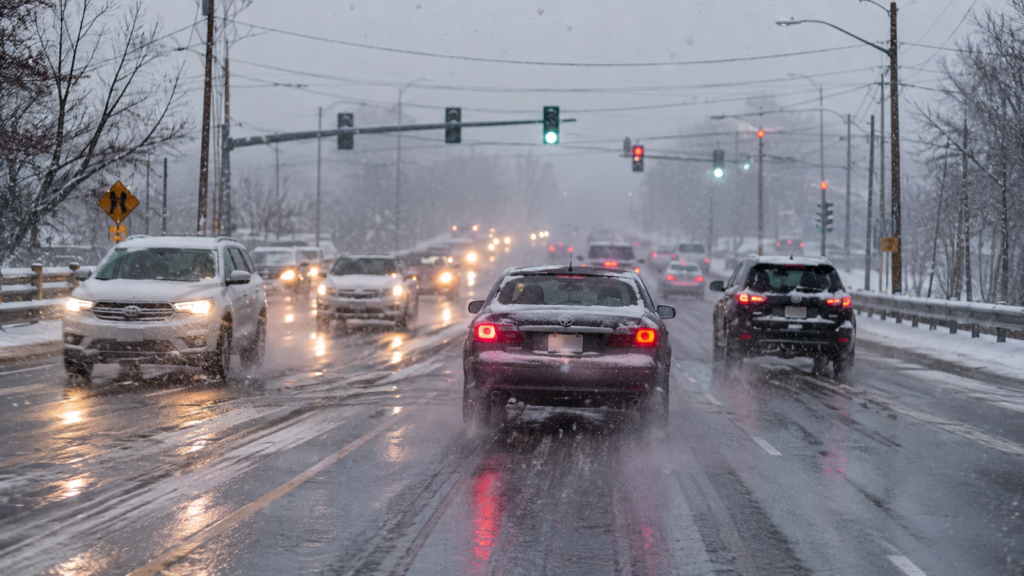
Cleveland drivers deal with everything from summer downpours to Lake Erie’s lake-effect snow, and a citywide analysis of 7,636 traffic crashes recorded in 2024 shows how much those conditions shape crash patterns over the course of a year. This article looks at what the data reveals about weather, road surfaces, and lighting conditions in Cleveland crashes, and, just as importantly, what Ohio law actually requires of drivers when conditions turn difficult.
This is a companion piece to our broader 2024 Cleveland traffic crash data guide, focused specifically on the environmental factors behind the numbers.
A note on the data: The figures below represent reported, confirmed traffic crashes in the city of Cleveland during 2024. Like any dataset built from official crash reports, these numbers are illustrative of real patterns but do not capture every crash that occurred. Many crashes go unreported, and others are underreported in their severity. What follows represents the minimum, not the maximum, of what happened on Cleveland roads in 2024.
What the 2024 Data Shows About Weather
Clear weather was present in the majority of Cleveland’s 2024 crashes (4,840), followed by cloudy conditions (1,184), rain (938), and snow (469). At first glance, that might suggest clear weather is somehow more dangerous. In reality, it mostly reflects exposure: Far more driving happens on clear days than during storms, so clear-weather crashes accumulate in raw numbers even if the per-mile risk during bad weather is higher.
A smaller number of crashes involved more severe weather: freezing rain or drizzle (37 crashes), fog, smog, or smoke (25), and sleet or hail (23). These conditions are less frequent in Cleveland but tend to reduce both visibility and traction sharply when they occur.
Road Surface Conditions
Road surfaces told a similar story. Most Cleveland crashes in 2024 happened on dry roads (5,567 crashes, or about 73% of the citywide total), but wet pavement was a factor in 1,431 crashes, close to 1 in 5. Winter conditions added further risk: 356 crashes happened on snow-covered roads and 160 on ice, together accounting for more than 500 crashes over the year.
- Dry: 5,567 crashes (about 73%)
- Wet: 1,431 crashes (about 18.7%)
- Snow: 356 crashes
- Ice: 160 crashes
- Slush: 25 crashes
Because Cleveland’s wet and winter-condition crashes are concentrated in a relatively short window of the year, roughly late fall through early spring, the per-day risk during that stretch is meaningfully higher than the annual averages suggest.
Lighting Conditions and the Dusk Connection
Daylight hours accounted for the largest raw number of crashes (4,553), which is unsurprising given how much more driving happens during the day. But dusk conditions stand out: 2,460 crashes, nearly a third of the citywide total, happened during dusk. That figure lines up closely with Cleveland’s 2 to 6 p.m. evening crash peak. For a large part of the year, especially fall and winter, dusk in Cleveland falls squarely within rush hour, meaning drivers are frequently navigating both heavy traffic and reduced visibility at the same time.
“A Cleveland commuter driving home at 5 p.m. in January is often doing it in the dark, in traffic, and possibly on a wet or icy road, three risk factors stacked on top of each other.”
Crashes in fully dark conditions were comparatively less frequent (150 combined for lighted and unlit roadways), but low-light and nighttime crashes are frequently more severe due to reduced reaction time and visibility.
Ohio Law: Weather Is Rarely a Defense
A common misconception is that bad weather automatically shifts fault away from the driver, or that a crash “caused by the weather” is not really anyone’s fault. Ohio law does not see it that way. Drivers have an ongoing duty to operate their vehicle at a speed reasonable for the conditions and to maintain an assured clear distance ahead, obligations that apply with even more force in rain, snow, or fog, not less. A driver who fails to slow down for wet or icy roads, or who follows too closely given reduced visibility, can still be found negligent even though the weather played a role in the crash.
This does not mean weather-related crashes are simple. Establishing what a “reasonable” speed or following distance looked like on a specific stretch of road, at a specific time, in specific conditions, often requires careful investigation, including weather records, road maintenance logs, and crash reconstruction. Ohio’s efforts to fund road, bridge, and infrastructure improvements are aimed in part at reducing this kind of risk, though Ohio’s infrastructure investments take time to reach every corridor.
Plevin & Gallucci’s Position on Weather-Related Crashes
We have represented thousands of Cleveland clients injured in crashes tied to every kind of weather this city sees, from a summer downpour on I-90 to black ice on a residential side street. In our experience, insurance companies frequently try to characterize a weather-related crash as a simple accident that nobody could have prevented. Ohio law does not support that framing. A driver is responsible for adjusting to the conditions in front of them, and when they do not, that failure is negligence like any other.
What most people get wrong
Many drivers and even some claimants assume that if the police report lists “wet” or “snow” as a contributing condition, that automatically limits or eliminates the other driver’s liability. It does not. The weather may explain why the road was slippery, but it does not excuse a driver from adjusting their speed, distance, and attention accordingly.
Our recommendation
If you were injured in a Cleveland crash where weather or road conditions were a factor, document the conditions as soon as possible, including photos of the road surface and any available weather data for that day and location, and speak with an attorney before that evidence is lost. Call Plevin & Gallucci at 1-855-4-PLEVIN or schedule a free consultation at our Cleveland office, 55 Public Square #2222, Cleveland, OH 44113.
The Plevin & Gallucci Team
Frequently Asked Questions
Does bad weather mean no one is at fault for a Cleveland car accident?
No. Ohio drivers are required to adjust their speed and following distance for weather and road conditions. A driver who fails to slow down for rain, snow, or ice can still be found negligent even though the weather contributed to the crash.
How many Cleveland crashes in 2024 happened on wet roads?
Wet pavement was a factor in 1,431 Cleveland crashes in 2024, about 18.7% of the citywide total.
Why do so many Cleveland crashes happen at dusk?
Dusk crashes made up nearly a third of Cleveland’s 2024 total, largely because dusk overlaps with the city’s evening rush hour for much of the fall and winter, combining reduced visibility with heavy traffic.
Can I recover damages if my Cleveland crash happened in the snow?
Yes. Snow and ice do not eliminate a driver’s duty to drive safely. If the other driver was going too fast for conditions or failed to leave adequate following distance, you may still have a valid negligence claim.
What should I do after a weather-related crash in Cleveland?
Seek medical attention, document the road and weather conditions at the scene if possible, request the official crash report, and speak with an attorney promptly, since evidence about road and weather conditions can be time-sensitive.